
This is an excerpt from “Going 15 Rounds With Jerry Izenberg: A Collection Of Interviews With The Legendary Columnist.”
Chapter 7 (an excerpt): On Courage and Heroism
By Ed Odeven
Through the ages, scholars and sidewalk merchants, cashiers and chiropractors have contemplated what courage means as it applies to their daily lives. Different definitions are, of course, recognized by different groups during different eras in different societies.
Ernest Hemingway took a stab at defining its meaning and its importance.
“Few men are willing to brave the disapproval of their fellows, the censure of their colleagues, the wrath of their society,” Hemingway wrote in “A Farewell to Arms.”
“Moral courage is a rarer commodity than bravery in battle or great intelligence. Yet it is the one essential, vital quality of those who seek to change a world which yields most painfully to change. ”
In his long career as a sports columnist, Jerry Izenberg has seen more than a few athletes who can be considered courageous and brave.
Greco-Roman wrestler Jeff Blatnick occupies a special spot in this category.
More than 30 years after Blatnick’s gold medal-winning triumph as a super heavyweight at the 1984 Los Angeles Summer Olympics, Izenberg remembered the challenges he had to endure to compete in California on the global stage, but first and foremost, to survive before even getting there.
“He develops cancer,” Izenberg said. “He might die. He’s living in upstate New York and he says to his parents, ‘You can give me one great gift. Let me move out and move into the Y (YMCA). I’m gonna train. I’m gonna get better. I’m gonna take my radiation and whatever and I’ll come home every weekend to spend with you, I promise.’ ”
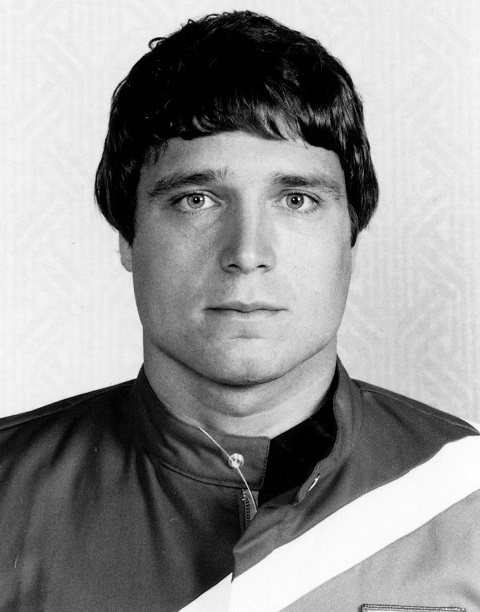
Izenberg spoke about Blatnick’s battle with Hodgkin’s disease, which he was diagnosed with in 1982.
“But,” he continued, relaying Blatnick’s message to his parents, “no questions about, ‘you don’t look good, you didn’t eat enough.’
“They go along with it. He comes back and he makes the Olympic team.
“Now somebody told me what a great story this is. So I got his name, and it’s the (early days) of computers, and now I know why AT&T computers went out of business. … I type his name under ‘USA,’ and it has his last name, first name and (information not found).
“Well they didn’t know he was on the team; I found him because he won the gold medal, and I was there (in Anaheim), when he won it.”
The Hartford Courant recounted Blatnick’s Olympic triumph in a November 1996 article.
“Cancer was a part of my life, a part of my life I had to deal with,” Blatnick said, according to the article.
“But I learned that I could overcome adversity. Faith and attitude go hand in hand. ”
Looking back at Blatnick’s gold-medal match, the Courant’s Tommy Hine reported: “When the bout ended, Blatnick dropped to his knees, kissed the mat and crossed himself. Unable to maintain his composure through much of a television interview, he walked off camera, saw his parents and broke down and wept in his mother’s arms.”
To this day, Izenberg recognizes the meaning of Blatnick’s accomplishment.
“It was a great story,” Izenberg said.
“And a year and a half later, the cancer came back, and he said, ‘Damn it, I’m gonna beat it again.’ And he took radiation and at the last treatment (on Valentine’s Day, in 1986) he shows up in a raincoat, and he opens the rain coat and he’s got on tails. He flips this thing he’s carrying and it’s a top hat, and he’s got a bottle of champagne for the nurses.”
Pause for a moment to imagine that scene straight out of a made-for-TV movie.
Then listen to Izenberg continue his recollections of a conversation from the mid-1980s: “And I said, ‘Why did you do that? Gratitude?’
“And he said, ‘No, when is the last time anybody working in that (hospital) ward could smile? That’s what I wanted and that’s what I got.’ ”
Blatnick, who carried the U.S. flag at the Closing Ceremony during the ’84 Summer Games, didn’t compete at the 1988 Seoul Olympics. He became a wrestling coach at a high school in New York and devoted time to charitable causes and other endeavors. He joined the board of directors for Gilda’s Club, the late comedienne Gilda Radner’s support centers for those with cancer. (Blatnick established a Gilda’s Club in New York.)
“Those are acts of heroism,” Izenberg said.
Blatnick passed away at age 55 in October 2012. The cause of death was complications following heart surgery, media outlets reported.
***
Going 15 Rounds With Jerry Izenberg is available for purchase via Amazon, Barnes & Noble and many other online bookshops.
What are people saying about the book? Check out this compilation of readers’ comments.

