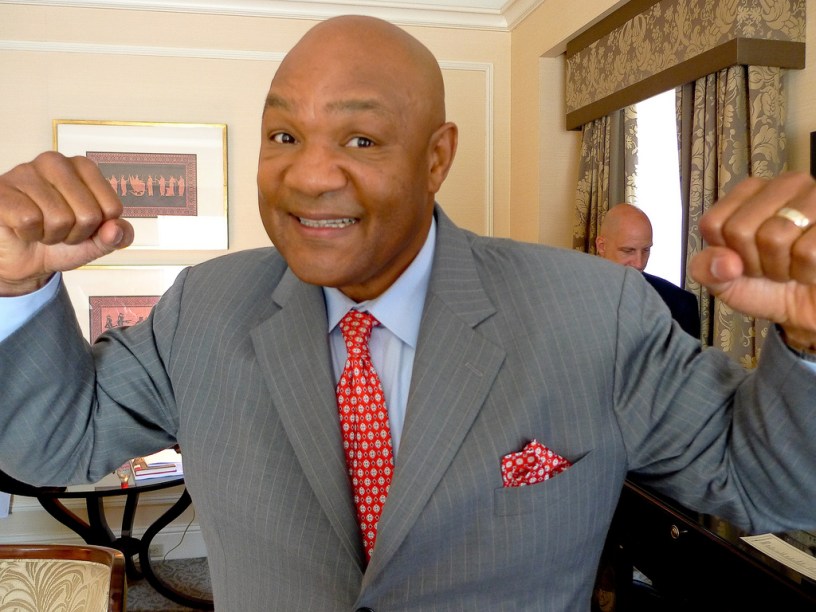
Sometimes, things just fall in to place.
How do you arrange a phone interview with someone who once fought Muhammad Ali, one of the five most famous people in the world throughout his adulthood, and later became one of his best friends?
Simply put, George Foreman responded to my DM inquiry on Twitter, sharing his email address. We then agreed on a workable time for a phone interview. He was incredibly generous with his time, granting me more than 2 hours to chat.
What’s more, there was no red tape, no army of PR handlers to scrutinize my questions. Nobody to interfere with my goal of interviewing Foreman or to say that X, Y or Z were topics he wouldn’t discuss.
I interviewed George Foreman in 2018 and wrote a three-part series that appeared in The Japan Times.
Without a doubt, it’s one of the highlights of my career as a sports reporter, columnist and editor.
RIP, George.
***
Part 1
From Juvenile Delinquent to World Champ
By Ed Odeven
George Foreman’s boxing career defied logic. To be heavyweight champion of the world in his 20s and to repeat the feat in his 40s, was unexpected — and historic, too.
There’s so much more, of course, to Foreman’s story. The popular pitchman. The preacher. The fight commentator. We’ve witnessed various stages of this larger-than-life figure for decades.
In Japan, Foreman fought twice, winning both times. The bouts represented different chapters in his improbable career (more on those fights in the second installment). Foreman knocked out Jose Roman in the first round, after two minutes had elapsed, on Sept. 1, 1973, at Tokyo’s Nippon Budokan in his first WBA and WBC heavyweight title defense. Likewise, Foreman had pulverized Joe Frazier that January in Kingston, Jamaica, knocking him down six times in two rounds, to become world champion.
Fast forward to Nov. 3, 1996, at Tokyo Bay NK Hall in Urayasu, Chiba Prefecture, where Big George in his wildly successful second chapter as a fighter — he began his comeback in 1987 — earned a unanimous decision victory over Crawford Grimsley. It was one of 81 pro fights for the Texas native, who won 76 times, 68 by knockout before retiring a second time at age 48.
This summer, Foreman discussed his career in the ring and life at his ranch in Marshall, Texas (where there are cows, chickens and goats, “but mostly I raise gate horses, horses that run real fast within a gate and don’t gallop, because I don’t like falling”) in an exclusive interview with The Japan Times. He also revealed details about preparation for sermons (he confessed that he’s read the Bible in its entirety several times), his zest for entrepreneurial opportunities (including the George Foreman Lean Mean Fat Reducing Grilling Machine, which has sold more than 120 million units worldwide) and much more.
“Most of the time I’m on the road, and if I’m not on the road traveling, speaking, making public appearances or doing TV shows, I’m preparing or resting up for one,” Foreman said by phone from his ranch. “So typically for me I’m busy and I spend most weekends in church where I’m still a pastor at the Church of the Lord Jesus Christ (in Houston). But typically, I’m travelling all the time.”
Despite his busy lifestyle, Foreman, who turned 69 in January, confirmed that he’s full of energy.
“I really feel good now, I had a chance to really get into changing the way I eat. I no longer eat like I’m the heavyweight champion of the world. I eat like a man just trying to live more years, so with that in mind I’m healthier, very healthy.”
In October, Foreman visited Mexico City to commemorate the 50th anniversary of his unexpected gold-medal triumph in the Olympic heavyweight competition. World Boxing Council president Mauricio Sulaiman, whose late father Jose previously held the top WBC post, was among those who paid tribute to Foreman for his glorious achievement.
“This day has a very special meaning because it is necessary to take a few minutes to remember the glory of having been the venue for a sporting event as important as the Olympic Games,” Sulaiman was quoted as saying by fightnews.com. “George Foreman, a man who represents the best of boxing, a life of success and service that has been an example of overcoming and surrender, but above all of love to God.”
Life transformation
As a teenager, the high school dropout’s life lacked direction. Foreman’s life changed for the better when he left Houston’s Fifth Ward and joined the Job Corps after he heard a TV advertisement featuring football legends Johnny Unitas and Jim Brown promoting the corps’ opportunities. In March 1974, Foreman told The New York Times, “I tried harder than you can imagine to be tough. I worked at it. Trouble was, I was a failure at crime. . . My heart really wasn’t in it. I thought I wanted to be a great thief and hustler. Every time we’d go to steal something, I’d either get caught or I’d drop what I was supposed to be stealing.”
First, he went to Grants Pass, Oregon, to study carpentry in 1965. The Job Corps then dispatched him to Pleasanton, California, where he earned his high school diploma. That’s also where boxing became a promising possibility and where he expressed an interest in it.
A Job Corps counsellor named Charles “Doc” Broadus, a former U.S. Air Force sergeant, encouraged the 16-year-old to give it a shot. It was Foreman’s second day in Pleasanton, he said.
“He told me to come down to the gym and try out and it was a little harder than I thought, and I wanted to hide from him and he said, ‘George, I thought you wanted to be a boxer. Are you scared?’ ” Foreman recalled. “I told him, ‘No.’ I didn’t have any shoes, and he made me sit down on the ground and he said wait and brought me some boxing shoes back.”
Listen to Broadus’ orders to Foreman, which he recounted decades later: “Now get down to the gym.” For Foreman, why was that so significant?
“It was the first time someone believed in me and gave me a chance,” he told The Japan Times. “If it had not been for Doc Broadus, there would not be George Foreman, a success story at all. What he meant to me, he didn’t say a lot to me about boxing — it was all ‘stick and move, George, stick and move’ — and it was enough, and that was enough to take me to an Olympic gold medal.”
Foreman collected gold in Mexico City with Broadus in his corner. He defeated Poland’s Lucjan Trela, Romania’s Ion Alexe, Italy’s Giorgio Bambini and the Soviet Union’s Jonas Cepulis in succession to capture the title.
And it paved the way for his future as a professional pugilist. He made his pro debut in June 1969, beating Donald Walheim at New York’s Madison Square Garden via a third-round knockout. A dozen more fights followed that year and 10 more KOs.
What made Foreman such an invincible, potent knockout artist?
“Fear was the determining factor,” he has said many times.
He expounded on that point in a fascinating question-and-answer session after a speech at England’s University of Oxford in June 2016. “And the one time I didn’t have fear,” Foreman said inside Oxford Union, “I fought Muhammad Ali in Africa. No butterflies, no fear. And it was the only time, truly, that I lost . . .”
Ali, who passed away in June 2016, was known for his gift of gab. But Foreman delivered a few zingers of his own.
To wit: After becoming heavyweight champ the first time (he then regained the title in 1994 at age 45 against Michael Moorer in Las Vegas), Big George displayed unwavering faith in his ability to obliterate his fistic counterparts inside the ring. In his memorable appearance at Oxford, which is posted on YouTube, Foreman illustrated that point. He held up his right hand, making a fist. He said, “This is my judge. Then, after raising his left hand, he stated, “This is my referee.”
Indeed, his hands created mayhem.
And then he met challenger Ali, a former and future heavyweight champ, in Kinshasa on Oct. 30, 1974. At the time, Foreman possessed a 40-0 record with 37 knockouts as pro. Going into the fight, Ali, the 4-1 underdog, was 44-2 with 31 KOs.
That aura of invincibility disappeared as Ali employed his rope-a-dope strategy, absorbing a punishing beating from Foreman in the early rounds. In the eighth round, Ali knocked out Foreman to reclaim the title. More than four decades later, that fight remains one of the most famous upsets in sports history. The Rumble in the Jungle is still one of the most discussed fights of all time.
Though Foreman later said he wanted a rematch with Ali, it never materialized. Indeed, it’s partly due to the fact that Foreman retired after a loss to Jimmy Young in 1977, while Ali kept fighting until ’81. He had a spiritual awakening after the fight in his dressing room and then became a Christian preacher. (At Oxford, he told the story of a how he heard a voice inside his head during that transformative experience, describing it this way: “You believe in God. Why are you scared to die? I don’t want your money, I want you.”)
The seemingly invincible Foreman’s reign had ended, but the questions about how and why he lost to Ali continue to this day.
“People ask me, ‘How did you lose the fight to Muhammad Ali?’ Foreman told this newspaper. “I say he beat me with that good right hand. I loved that I was in the ring with him . . .”
“He hit me with the fastest one-two combination I’d ever seen, let alone been hit with,” Foreman insisted at Oxford.
Memories of Ali
As the conversation shifted to more personal matters, Foreman was asked when was the last time he interacted with The Greatest.
“The last time I actually saw Muhammad Ali by remote,” Foreman stated. “His daughter Hana Ali put him on FaceTime with me on the telephone, and that was less than a year before he passed away, and he looked at me and gave me a frown, then a smile, and he was so happy because he was eating something sweet. He loved to eat sweet things, and it looked like someone had made him a piece of watermelon on a stick, and then showed it to me, like, ‘Look at this,’ and then he ate it. He was so happy.
“But before then, I’d seen him on his 70th birthday party in Las Vegas. . . . We spent time (together). We hugged and talked and everything. I loved that man. To this day, I still love him. I love him and miss him. He was my oldest living friend when he passed away.”
Another tale from Foreman’s early days as a pro brings a smile to his face to this day. It was in December 1969, when he was preparing to fight Levi Forte.
“My favorite story about Muhammad Ali is I first met him in Miami, Florida,” Foreman said. “I was going to box my first 10-rounder. So the television people came to film me that day, and he must have heard about it. They didn’t want to film him. They wanted to be certain that he wouldn’t even be in the photographs. . . . But anyway, he came up the stairs and I could hear him walking up the stairs and he shouted, ‘George Foreman . . .’
“He saw I admired him. He said, ‘Stay here, I’m going to show you what you’re going to have once you become heavyweight champ of the world like me,’ ” Foreman recalled.
“I sat down and waited for him after my workout, and he came back up the stairs with all that noise and said, ‘look.’ He had a briefcase with him. I thought he was going to show me a hundred thousand dollars cash. I opened the briefcase and I waited, and there was a telephone. A briefcase telephone, and in those days there weren’t cellphones at all. . . . He had a telephone in a briefcase and he picked it up and said, ‘See, you can have this once you become champ of the world.’ I expected more,” Foreman added, chuckling.
And what was the first thing Foreman purchased after becoming the heavyweight champ?
A briefcase telephone for about $300-$400.
What does Foreman miss most about Ali, whom he admitted hating after the loss in Zaire before becoming his close friend a few years later?
“Just him being around,” Foreman said. “I would do an interview and I would achieve something, and it would all be because it was built around him — Muhammad Ali did this and Muhammad Ali didn’t do this. My whole life was built around him.
“One day we spoke on the telephone, and I’ll tell you how competitive he had been. And he sent me a photograph of his son and his grandson. He was holding them, I said, ‘Wow.’ And then I sent him back a photograph of my grandson with me. He got so competitive he sent me three (photos). He had three grandsons. He wanted to win everything. . . . He wanted to make certain I knew he had more than just one. He wanted to win.”
Winning, of course, produced thrills in the ring. Above all, though, from the era of his influential trainer Broadus, who was born in 1919, helped guide Sugar Ray Leonard’s legendary career and passed away in 2008, to the present day, a century of boxing history flows through Foreman’s veins. He cherishes its history and respects the legends of the sweet science.
Which is why Big George’s aforementioned triumph over Frazier still resonates with him 45 years later.
“The first time I won the championship of the world it was like, ‘I can’t believe it.’ Once you become champion of the world, it’s like, Jack Dempsey, Jack Johnson, Joe Louis, John L. Sullivan, Muhammad Ali!” he proclaimed, his voice rising a few decibels. “. . . It’s like they all just run into your body like a rush. You know that you’re the champion of the world and you feel it. You feel like something ancient all of a sudden. You don’t feel like the regular guy anymore. I felt like an ancient being from way back in the past. That was a rush like none other.”
***
Part 2
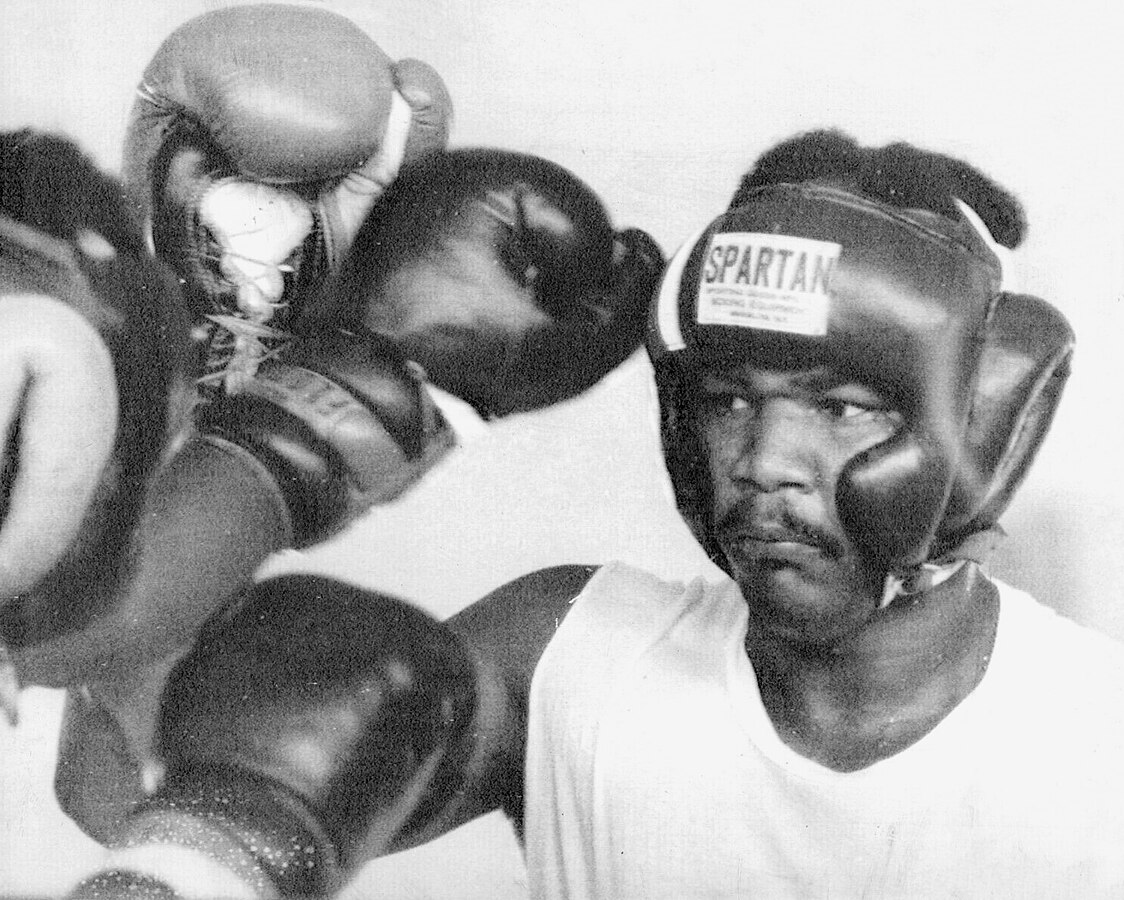
George Foreman: Reflections on His Bouts in Japan
By Ed Odeven
When he was presumably closer to retirement home age than prime-time sports figure, George Foreman produced one of the most stunning feats in modern sports history.
Foreman’s 10th-round knockout of Michael Moorer in Las Vegas on Nov. 5, 1994, made him the oldest heavyweight boxing champ in history. He was 45 years, 360 days old. An ancient man in a young man’s sport. (The former oldest heavyweight champ, Jersey Joe Walcott, was 37 when he achieved the feat with a seven-round KO of Ezzard Charles on July 18, 1951, in Pittsburgh.)
By becoming heavyweight champion for the second time, Foreman ensured a more prominent place for himself in the annals of the sport — nearly two full decades after going toe-to-toe with Joe Frazier (dropping the legend six times in two rounds in 1973 in Kingston, Jamaica, to become title holder) and then challenger Muhammad Ali (losing via an eighth-round KO in the Rumble in the Jungle on Oct. 30, 1974, in Kinshasa, Zaire).
“He had my number”, Foreman said of Ali. “He had my number, that’s all. But I had Joe Frazier’s number, Michael Moorer’s number, Ken Norton’s . . . I had almost 80-something people’s numbers, but Muhammad Ali had my number. I can’t change that.”
In a recent interview, Foreman, now 69, analyzed what happened inside the squared circle against Moorer, who was 27 at the time. He also spoke in detail about his two fights in Japan, which took place 23 years apart and nearly bookended a legendary career.
Against Moorer, Foreman believes that he outsmarted the New York City native, and that his strategy was superior.
“I knew I wouldn’t be able to win the fight by points because of what happened with (Tommy Morrison),” told The Japan Times by phone from his ranch in Marshall, Texas. Morrison defeated Foreman by unanimous decision in their 12-round fight for the vacant World Boxing Organization heavyweight title on June 7, 1993, in Las Vegas. Foreman continued: “I knew I’d have to get a knockout, and I knew I wouldn’t be able to do it in the first or second round. I’d have to do it later.”
For Big George, who had retired in 1977, become a Christian preacher and returned to the ring a decade later in a much-publicized successful comeback, veteran experience paid off. The Moorer fight was a showcase for his still-present skills. (Various insights on his post-fighting life are included in the third installment.)
In other words, the strategy to exhibit patience with Moorer, a former light heavyweight champion, was spot-on.
“Michael Moorer believed he was the better puncher,” recalled Foreman, who never sparred with or fought against Mike Tyson. “At the fighters’ meeting they asked which gloves we were going to use. Michael Moorer insisted on the Cleto Reyes glove. We call them the puncher’s glove. Most times, when people fight me they try to go to the Everlast gloves, because it’s like they have air in them, and they’re not the complement of a puncher; they are mostly a glove you can box on a guy with. And I said, ‘Is he crazy?’ He actually believed that he was the puncher and that I was a boxer. I said, ‘Man, this thing is falling into my hands everywhere I go.’ ”
He went on: “So I knew if I dropped him at all, it was going to be once and for all, so I waited around and landed body shots, hooks to the side . . . and I karated with him a few times. He, of course, was a better boxer and stayed on the outside. Then finally, he decided he wasn’t going to run from me, and the knockout just presented itself.”
Nearly a quarter century after Foreman recaptured the world heavyweight title — the WBA and IBF versions — in the confusing alphabet-soup organizational landscape of pro boxing — he credited Moorer for demonstrating bravery in their mano a mano clash.
“He didn’t run from me, he didn’t hide,” Foreman said of Moorer.
There remains, however, a misconception that has been published in various articles about the knockout artist’s attire for the Moorer fight, he said.
Given the chance to set the record straight, Foreman said he didn’t wear the same trunks against Moorer that he had donned for the Rumble in the Jungle.
“Everlast made a series of (customized) boxing trunks for me,” he told The Japan Times. “And the trunks I fought in I had fought in when I was heavyweight champion of the world (in the 1970s), but they were not the trunks that I fought Muhammad Ali in. They were just trunks I had fought in as the heavyweight champion of the world.” Perhaps against Ken Norton, he added.
“People keep making that story (up),” he went on, “but I tell them these trunks said ‘George Foreman, heavyweight champion of the world,’ they had lasted all those years, so I put on my world heavyweight championship trunks to get in the ring (with Moorer). “I’m a minister now, so I’m not just gonna lie, you know what I mean? I’m just not gonna do it.”
First title defense in Tokyo
Foreman, the 1968 Olympic heavyweight champion in Mexico City, retains vivid memories of his first fight in Japan. He defended his WBA and WBC titles on Sept. 1, 1973, at Nippon Budokan against Puerto Rican challenger Jose Roman.
The beatdown lasted exactly two minutes for the new world champ.
“I remember that fight and it was brutal,” Foreman told this newspaper. “It didn’t last long, but I was in my most brutal moment of my boxing career. . . . And I was always told, ‘George, don’t try to hit a guy on the top of the head or on the side of the top of the head, you’ll hurt your hands and you can hardly knock him out. You’ve got to hit him on the chin or close to the jaw.’ ”
Truth be told, Foreman didn’t follow that advice against Roman, who was appearing in his 52nd pro fight. But his punches produced the desired results.
“Well, this time I hit Roman right on the side of the top of his head,” Foreman recounted, “not on the middle part of his head . . . and I knocked him down and I said there, ‘I’m the hardest puncher that ever put on a pair of boxing gloves.’ ”
How was Roman’s condition afterward?
“He recovered good because the good thing about my punches is it’s not like the boxers who have to hit a guy a hundred times,” Foreman stated. “If I threw five shots and hit a guy once, it was gonna knock him down.
“I would pretty much knock them down, and that was pretty much their salvation that they would get knocked down.”
Against Roman, Foreman believes that he delivered those blows like a sledgehammer.
“Those punches,” he said, “were the most brutal I’ve ever (delivered) before or since in a boxing match.”
Powerful words from a fighter who recorded 68 — count ’em 68 — knockout victories in 76 pro bouts.
Donated portion of winnings
Foreman donated $10,000 from his Roman fight earnings to a home for handicapped children in Japan, according to news reports at the time. He couldn’t recall the name of the home, which didn’t appear in 1973 articles.
Asked if he had visited that home, Foreman said that he didn’t. But he stopped by other homes that supported children in need in the years that followed.
One of those homes, the Elizabeth Saunders Home, was established in 1948 in Oiso, Kanagawa Prefecture, to support biracial children, many of whom were abandoned, and Japanese mothers in the aftermath of World War II. The orphanage, affiliated with the Anglican Church of Japan, was named in honor of an Englishwoman who was the first person to donate money. (The home, still in operation, was established by Miki Sawada. Her grandfather, Yataro Iwasaki, founded the Mitsubishi business empire.)
“I visited her place and made sure she got a donation,” Foreman said of Sawada, who passed away in 1980 at age 78. “And a couple of kids from her place even became good boxers.”
That visit had a profound impact on Foreman. He called it the “most touching part of my life.”
Learning about Japan’s recovery from World War II from afar, as well as from earthquakes and other natural disasters over the years, including the Great East Japan Earthquake on March 11, 2011, Foreman paid tribute to the character of this nation’s people.
“You’ve got to understand that the people in Japan are the most resilient people in the whole world,” Foreman said.
Foreman estimates he’s made five visits to Japan over the years for work and leisure, including as a cast member of “Better Late Than Never,” a TV reality-travel program (and remake of the popular South Korean show “Grandpas Over Flowers” that also featured actors William Shatner and Henry Winkler, NFL Hall of Fame quarterback Terry Bradshaw and comedian Jeff Dye. In August 2015, production work began for the show in Japan. Season 1 aired in 2016 on American TV network NBC and included stops in Tokyo and Kyoto, among other locales in Japan and East Asia.
The show’s concept was straight forward: “The stars will travel around the world, experience new cultures and take another step in checking off their bucket lists,” The Korea Times reported.
Besides work for the TV show, Foreman was able to see Japan up close like he’d never done before.
“I got a chance to really meet people,” he said. “It was the best trip I ever had. There was so much to offer me that I didn’t know about. I thought I loved Japan, but I didn’t (really) know Japan until that ‘Better Late Than Never’ show.”
Showdown with Grimsley
Foreman encountered Crawford Grimsley at Tokyo Bay NK Hall in Urayasu, Chiba Prefecture, on Nov. 3, 1996, in a non-title fight that he won by outpointing his lesser-known foe. (Due to inactivity — e.g. not defending his titles — Foreman was stripped of his WBA and IBF belts in 1995.)
It was Grimsley’s first loss in 21 career fights up to that day. Foreman fought twice more before retiring for good.
“I tried to get him every chance I could … but the 12 rounds went by really quick,” Foreman said, looking back on the bout. “But I expected that decision because I was after him every inch of the way.”
Angelo Dundee, Ali’s legendary trainer (1960-81), worked in Foreman’s corner.
Foreman remembered it as “a more reserved (crowd) than at other places around the world.”
“Some good-mannered people, more so than some people. I could’ve had the same fight in upstate New York and everybody would’ve been cussing and throwing stuff,” he added with a laugh.
What’s more, the day of the fight provided an unexpected, memorable experience for Foreman: He met MLB superstar Barry Bonds for the first time.
“He came up into the ring and shook my hand. That was the highlight of the whole fight for me,” said Foreman, who described Evander Holyfield and Ali as the smartest boxers he ever faced.
***
Part 3

George Foreman: After the Boxing Career, a Business Giant Emerges
By Ed Odeven
In his book “Only in America: The Life and Crimes of Don King,” the late author Jack Newfield noted that Sonny Liston had made a big impression on George Foreman.
This influenced Foreman’s demeanor as a fighter, including his facial expressions, which bore a striking resemblance to Liston’s during his pugilistic pursuits.
“Foreman had grown up trying to emulate the scowling menace of Sonny Liston,” Newfield wrote, “and he was deep into that intimidating persona leading up to the (Joe) Frazier fight.” In that January 1973 bout, Foreman dropped Frazier to the canvas six times, nabbing the WBA and WBC titles with a second-round knockout in Kingston, Jamaica. And they met again in June 1976, with Foreman earning a fifth-round TKO.
As contemporary news accounts reported, Foreman maintained the visible appearance of the Meanest Man on the Planet in those days.
That was then, this is now.
After his first retirement in 1977, the Houston native made a successful comeback a decade later en route to becoming the oldest heavyweight champion in history at age 45 in 1994. Upon his return, Foreman exhibited a more gregarious personality than former sparring partner Liston from whom he traded punches with in the run-up to the 1968 Mexico City Olympics, where he captured the heavyweight gold medal.
Like basketball Hall of Famer Magic Johnson, Foreman is often seen with an infectious smile during public appearances. His cheerful disposition also helped him transform into a successful businessman who became a sought-after pitchman for numerous projects. One of those products, the George Foreman Lean Mean Fat-Reducing Grilling Machine has sold more than 120 million units worldwide since its launch in the mid-1990s.
“My greatest strength (as a businessman) is that I know there’s no good deal unless everyone is happy about it,” Foreman told The Japan Times by phone from Texas.
Naturally, he’s derived satisfaction from the popularity of the George Foreman Grill, and not just because of the financial security that’s linked to it.
“The great thing about pitching the George Foreman Grill was that it worked,” he said. “Back in the day you could sell a lot of things, but none that you really say it truly worked. That was the most satisfying thing about the George Foreman Grill to me.”
Foreman personally shipped several of his famous grills to Ali because “I wanted him to have as many as he wanted.”
Joy from giving, learning
Yes, the two-time world champion is an endearing figure in large crowds and small gatherings. And Foreman has used his fame and fortune to help the youth of Houston, his hometown. He opened the George Foreman Youth and Community Center in 1984, several years after he became an ordained minister.
Foreman told a story about meeting one of the center’s former attendees years later that brought him joy.
One day in Houston, he said, “I was driving a convertible and I stopped at a service station to get my car filled. The young man filled my car up, washed the windows and I got ready to leave and he said, ‘Just wait for a moment.’ And he came back, the young man did, and gave me $5.
“I said, ‘What is this for?’
“He said, ‘When I wanted to be on your boxing team, I didn’t have $5 to buy handwraps, and you told me I’m going to give it to you, but you owe me $5.’
“And there he was a grown man and he said, ‘Can you sign this picture for my daughter?’
“And I felt like my youth center was successful. That meant more to me than if I had trained the heavyweight champion of the world when that man said here’s your $5 back. He never forgot me and that’s when I knew the youth center had been a benefit (to the city).”
Foreman, who has expressed his love of reading numerous times, admitted his quest to study the Bible is an ongoing passion.
“I’ve read the Bible in its entirety several times, and even to this day I continue to read and read again the Bible,” Foreman said.
Memorizing a biblical passage and fully grasping its meaning are two different things, according to Foreman,who made his first title defense in Tokyo against Jose Roman on Sept. 1, 1973, winning via a first-round knockout at Nippon Budokan.
He cited the entire chapter of Psalms 1 as his favorite Bible passage. He then recited a portion of the scripture:
“Blessed is the man who doesn’t surrender to bad counsel . . . who doesn’t take any bad advice.”
He then said: “It didn’t say blessed is the man who has a Rolls-Royce, but the man who doesn’t take bad advice, and I love that because my blessing is that for almost 32 years now I’ve gone with the advice of the Bible. I don’t take bad advice.”
In the spotlight
For Foreman, local, national and international media exposure is a constant, even if he never fought in the 21st century. Individuals born during the past 15 to 20 years may have limited or no knowledge of his fighting career, but in the annals of boxing history he is a seminal figure.
For instance, The Ring magazine, aka the Bible of Boxing, which was founded in 1922, commissioned well-known boxing scribe Thomas Hauser to write “The Greatest Heavyweights of All Time.” The feature was published in the May 2017 issue.
Ali tops the list, followed by Joe Louis, Jack Johnson, Rocky Marciano, Larry Holmes and Jack Dempsey. Foreman was selected at No. 7, with Frazier, Mike Tyson and Sonny Liston rounding out the top 10. Tied at 11th were Lennox Lewis and Evander Holyfield, followed by Gene Tunney, John L. Sullivan and James Jeffries. Brothers Wladimir and Vitali Klitschko were Nos. 16 and 17, with James Corbett, Riddick Bowe and Bob Fitzsimmons wrapping up the top 20.
“A lot of people who are serious about boxing think George Foreman is one of the most underrated fighters ever,” Hauser wrote. “He fought his share of soft opponents. But he’s also one of the toughest men to ever box (watch the Lyle and Moorer fights). He’s one of the hardest hitters ever. And after being heavyweight champion, he came back more than a decade later to do it again.”
Hauser noted that Foreman evolved as a fighter and became a smarter boxer after his comeback.
“Foreman was a much better boxer the second time around,” Hauser wrote. “He was older and slower, but he’d learned to study his opponents and take advantage of what he saw.”
What’s more, “Ali fought Joe Frazier three times and Ken Norton three times. He didn’t mess with Foreman again after he beat him,” Hauser pointed out.
Instead of boasting about his notoriety, Foreman projects a humility that resonates with others. He’s a man of the people and enjoys interacting with others. Decades from now, additional chapters in the history books will be written about his place in popular culture. The Rumble in the Jungle, of course, stands out as one of the defining events in his life.
That eighth-round knockout defeat to Ali on Oct. 30, 1974,in Kinshasa, Zaire, ended his reign as world heavyweight champion and later spawned an Academy Award-winning documentary, “When We Were Kings,” which was released in 1996.
Active online presence
From his days on TV as a pitch man for KFC, Midas and many others, Foreman’s face is quite recognizable to the generations that grew up after he fought Ali in Kinshasa.
Nowadays, he’s expanded his global outreach via social media. It’s a regular part of his schedule, especially Facebook and Twitter, and a routine that he started around 2010.
“Yeah, I like that. That keeps me busy,” Foreman told this newspaper. “What I wanted to do more than anything the last 25 years is to stay in touch with people, and I get a chance to talk to people from every walk of life. That’s why I do Facebook and Twitter.”
In October, he was asked who was the sporting hero of his youth. “The Great Jim Brown,” Foreman tweeted. “Hero forever for me.”
Asked for a few details of his social media routine, Foreman offered this insight:
“In the evenings, I do Twitter. . . . I’ll pick maybe two hours to do Twitter, an hour and a half to do Twitter, and then early mornings I have my daily quotes. . . .
“So I try to get in and get a quote (posted) early in the mornin’ before people get up, so they’ll wake up to something new that I’ve said.”
Tales from the past
Foreman retains many memorable details from his countless conversations with Ali over the years. One, from the 1970s, that illustrated his fondness for the lively characters who make a living in boxing.
“He called me one day after they (boxing officials) had put pressure on him to fight Ken Norton again,” Foreman recounted before adding, “ ‘George, they are forcing me to fight Ken Norton again.’
“He said, ‘George, I can’t beat Norton. I can’t beat him. I’ve tried everything but I can’t beat him.’ But he said, ‘George, you can beat him.’
“I said, ‘No, I’m a preacher now, giving my life to God. But he said, ‘the people in the Bible, they had fights.’
“I said, ‘But I’m not fighting anymore.’
“He said, ‘If you come back, I’ll give you a title shot. I’ll let you use my training camp. Just beat him, please. He doesn’t represent anything, George.’
“He begged me to come back and beat Norton, and I told him, ‘Nope, can’t do it.’ ”
Ali and Norton ultimately wound up fighting three times, with The Greatest winning twice.
In a conversation on “Larry King Now” in 2015, the world-renowned interviewer asked Foreman what was his best attribute as a boxer.
“I never took a step back,” Foreman told King.
With that in mind, Foreman was asked to compare his punching power from past decades to the present time.
“Periodically, I will get on the punching bag,” Foreman said. “And after working two or three days I throw my hardest punch, and the power is still there. It’s still there the way it was when I left in ’97.”
***
Ed Odeven is the author of “Going 15 Rounds With Jerry Izenberg: A Collection Of Interviews With The Legendary Journalist.”
 Ed Odeven Reporting
Hi Ed, great interview with my friend, the Great George Foreman. My relationship with George and Ali was one of the most unique in boxing history.
I will be subscribing to your blog. I am preparing to get back into the Podcast business. Looking forward to interviewing you. Stay tune.
HBell