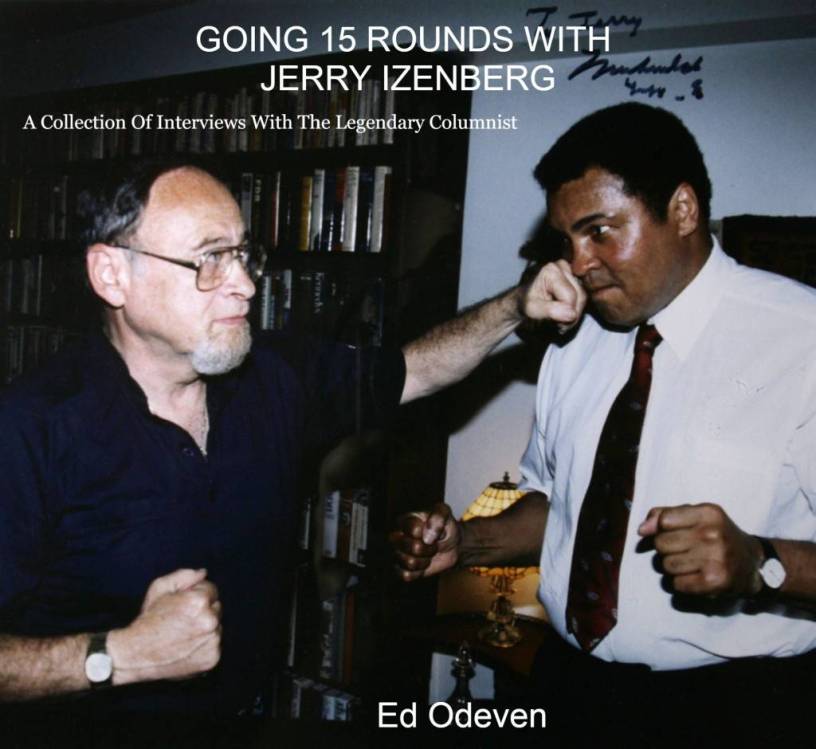
This chapter appears in “Going 15 Rounds With Jerry Izenberg.”
***
“He was one of the greats of this era, absolutely.”
-Dave Anderson
Few sports journalists can claim they have — or had — the same breadth of knowledge about Jerry Izenberg as Dave Anderson.
That statement, composed in June 2018, underscores the longevity of both men’s lives, and highlights their contributions to sports journalism, particularly newspapers.
Anderson, born in New York in May 1929, graduated from high school in 1947, the same year that Jackie Robinson of the Brooklyn Dodgers broke Major League Baseball’s color barrier. And Anderson was a sharp observer of contemporary sports media and its rich history, which was evident during a phone interview in 2016 for this book. (He passed away in October 2018.)
The retired New York Times sports columnist lamented the decline of general sports columnists in the Internet age, recognizing he and his peers served a valued role in shaping opinions in locales big and small.
“But the way the newspaper business is now, pretty soon there won’t be any sports columnists,” Anderson said from his New Jersey home.
“Writing on the Internet, writing a blog, isn’t the same as a day -to-day newspaper columnist,” he added.
Indeed, it’s a different era now — and not necessarily a better one.
“All of these blog guys are columnists now, virtually,” said Anderson, who won the Pulitzer Prize in 1981, a tribute to his sports commentary. Other sportswriters who have won the Pulitzer include Arthur Daley, Red Smith and Jim Murray.
Added Anderson: “What do they have in their background that made them so readable?
And who cares what these guys say? What have they done? Just because it’s on the Internet doesn’t mean it’s worthwhile.”
Izenberg, on the other hand, developed a distinct style while crafting memorable prose. His opinions have always been backed by pertinent facts and a keen observer’s understanding of how to tell a story.
Anderson, who wrote for the Brooklyn Eagle and New York Journal-American before moving on to The New York Times in 1966, said that Izenberg wrote columns that would jump out at you.
It was, Anderson stated, “just his style.”
“To me, it’s a Jerry Izenberg style. … It’s like your blood type, only its words.”
With a Red Smith Award on his resume, Izenberg belongs in the “Hall of Fame as a sportswriter in this country,” Anderson declared.
Anderson and Izenberg became acquainted with one other in the mid-1950s. Anderson couldn’t remember exactly when, but thought it probably was at a New York Giants NFL game in 1956 at Yankee Stadium when they first crossed paths.
Later on, during their extensive coverage of a golden age of heavyweight boxing, they became better acquainted.
In the 1970s, Anderson recalled, he saw Izenberg overseas during a trio of Muhammad Ali fights: The Rumble in the Jungle, Ali vs. George Foreman, in October 1974, in Kinshasa, the Democratic Republic of Congo (now Zaire); Ali vs. Joe Bugner, in July 1975, in Kuala Lumpur; and The Thrilla in Manila, Ali vs. Joe Frazier, in October 1975.
“Those were my favorite, my memorable trips with Jerry,” stated Anderson, who was inducted into the National Sportscasters and Sportswriters Hall of Fame in 1990, four years before he received the Red Smith Award.
“When you are covering an event, you are kind of concentrating on yourself, ” he went on, “so you’re not that aware of other people — you’re concentrating on the event and what you’re trying to think about and write about — but he was great fun to be with whenever we traveled. But he was also a great worker.”
Expanding on that point, Anderson noted that “I’ve always admired the guys, and I was always the same way, that not only did their newspaper work but also magazine articles and books.”
Anderson was a prolific reporter and columnist. During his illustrious career, he also wrote more than 20 books and 350 magazine articles.
“But he also went beyond that,” Anderson said of Izenberg, citing “Sports Extra,” a Sunday evening TV program that aired on Channel 5 in New York City in the 1970s. That program aired for eight years, and remains a memorable distributor of sports tales and opinions for adults of a certain age.
As a pundit, Izenberg crafted commentary that stood the test of time, Anderson insisted, explaining that Izenberg knew what he was doing and had a true passion for the work.
“He was a wonderful writer,” Anderson said. “He was a very colorful writer. If you just sit down and somebody gave you five different columns without the bylines from five different writers, you could pick out which one was Jerry Izenberg’s because that was his style. He was a very stylistic writer and a very good writer. He had humor in it, but also a lot of serious thoughts, and he also did some great books.”
With the conversation shifting to books, Anderson mentioned that he loved Izenberg’s “No Medals For Trying: A Week in the Life of a Pro Football Team,” about the 1989 New York Giants, who were coached by Bill Parcells. The book focused on Nov. 27-Dec. 3, 1989, with Izenberg giving readers an inside look at the team’s day-to-day routines over the course of that week.
“That was one of coach Bill Parcells’ favorite phrases: You don’t get medals for trying. You’ve got to win,” Anderson said.
Fast forward to 2014, when Izenberg published “Rozelle: A Biography,” his authoritative account of the late NFL commissioner Pete Rozelle’s life and legacy.
“Even in his so-called retirement now, he did a wonderful book on Pete Rozelle, a lot of which he saved from his notes from interviews with Rozelle, and it showed what a great craftsman and journalist he is,” said Anderson.
Asked what is Izenberg’s greatest attribute or strength as a journalist, Anderson responded without hesitation: “Devotion to the job.”
Because of that devotion, Izenberg earned the rightful reputation as a voice of authenticity about New Jersey. His opinions mattered. His convictions carried weight.
“I think he was the sports conscience of New Jersey,” Anderson insisted, “whether it was Rutgers University, whether it was basketball or football there, but he always had, which he should’ve had, he was writing for a New Jersey newspaper.
“The good and the bad of New Jersey was very important to Jerry.”
Did that extend to New York as well?
“To some extent, but he was the only one. I seldom wrote about the conscience of New Jersey, but he did,” Anderson said.
Izenberg famously developed close ties with Ali. It was a product of the times, according to Anderson.
“There were no barriers with Ali. … He was always available,” Anderson said.
“It was never a barrier, and the main reason for that was (legendary trainer) Angelo Dundee, but again Muhammad Ali went along with it, and there never was a day when Muhammad Ali said ‘no comment.’ ”
Anderson recalled in an interview that he covered 32 of Ali’s fights, “probably more than Jerry covered.” Izenberg then confirmed that Anderson was correct, stating that he covered 24 of The Greatest’s fights. While both men enhanced their reputations as sports scribes with distinguished boxing commentary, Anderson received induction into the International Boxing Hall of Fame in Canastota, New York, in 2008. It took eight more years before Izenberg was given the same accolade.
What took so long?
“I can’t answer that. … He should’ve been in years ago,” Anderson replied.
Nabbing awards, though, has never been Izenberg’s main focus. Commitment to his craft and devotion to his community were always at the top of his to-do list.
Anderson cited the Pride Bowl, started in 1979, as a shining example of Izenberg’s tireless work on behalf of the community.
In a 2005 feature in the New Jersey Jewish News, writer Ron Kaplan described the decades-long project, for which Izenberg was the president this way: “Project Pride, a Newark-based organization that provides kids with recreational opportunities, after-school tutoring, and college scholarships through proceeds from the annual Pride Bowl football game. The program has raised nearly $4 million and provided almost 1,000 college scholarships since its creation more than 25 years ago.”
“I can’t think of any other writer (who did this),” Anderson said, “and I’m sure there have been, but certainly not in my recollection locally, that he went out of his way to develop his Pride Bowl, which helped young people in Newark, mostly African-Americans.”
“He was the man that got things done,” added Anderson.
Sports Illustrated wrote a small article about Project Pride in December 1991.
“People don’t understand why I keep doing this,” Izenberg told the magazine, “but it’s a great feeling to make a difference in the lives of these kids; most of them have no chance.”
He got college teams (Seton Hall and Cheyney State competed in the first one; in Pride Bowl XXVIII, Army and Navy squared off in 2005, for example) to play in the game each year, using proceeds from the game to fund computers, science fairs and debate teams, for instance.
“I remember him talking about it almost every time, because I would see him at a lot of Giants football games,” Anderson remembered, “and in that era he would always talk to me about it.”
People in the business are certainly aware of Izenberg’s work, Anderson noted. Then, he said, “Well, I think if he had written for The New York Times or (New York) Daily News or The Washington Post, people would have been much more aware of him.
“The thing that probably is a factor in taking so long to be in the Boxing Hall of Fame is The Star-Ledger just doesn’t have the impact that fortunately I had at The Times, that a lot of guys had at various papers. (But) I think that doesn’t lessen his worth, let’s put it that way.”
***
Order “Going 15 Rounds With Jerry Izenberg” on Amazon, Bookshop.org, Barnes & Noble and other online shops.
 Ed Odeven Reporting