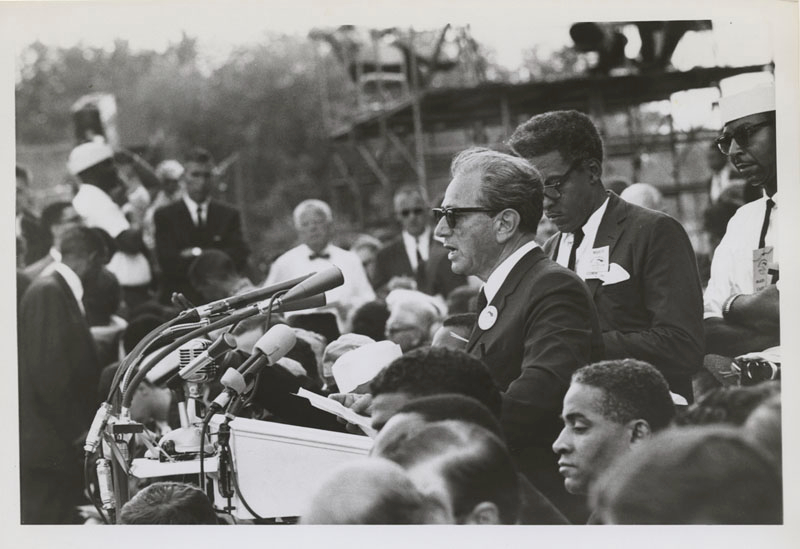
This is an excerpt from “Going 15 Rounds With Jerry Izenberg.” The legendary sports columnist shares memories of Rabbi Joachim Prinz, who was an influential figure, a moral compass, in his life. Prinz, who spoke out about Nazism, was kicked out of Germany in 1937, and was a civil rights leader in Europe and North America.
***
Chapter 14: A Rabbi’s Influence
Jerry Izenberg’s moral backbone, fiber, fortitude, compass ― whatever you choose to call it ― is directly linked to an important civil rights leader.
While Izenberg grew up in Newark, New Jersey, Dr. Joachim Prinz, a prominent rabbi and civil rights advocate, taught him, and taught him well.
“I was bar mitzvahed by a very famous rabbi, Joachim Prinz,” Izenberg said. “Joachim Prinz was a rabbi in Nazi Germany. He got out one step ahead of the knock on the door. He came here and was moved around the country a little bit and then he became the head rabbi at (Temple) B’nai Abraham, which was the largest synagogue in New Jersey, and it was on my block that I lived on.
“And it was where I would get bar mitzvahed,” he added, referring to the traditional ceremony and celebration for a Jewish boy on his 13th birthday. This occurred in 1943, during World War II, when the United States was fighting Hitler’s Germany.
“His first friends (in Newark) were my mother and father,” Izenberg said. “And my father, the old ballplayer, used to listen to the (New York) Giants games every night. And Dr. Prinz would come over and he’d sit with my mother and father on the porch and my father would have the radio on. My mother would be talking to him.
“One night he said to my father, ‘Harry, I need a favor,’ ” Izenberg recalled his rabbi saying. “My father said, ‘Not now, not now. (Giants legend) Mel Ott’s coming to bat. Wait, wait.’ Mel Ott struck out, prompting Harry Izenberg to blurt out, ‘What did you want?’ ”
“I want you to teach me baseball,” the rabbi said.
“And my father says, ‘I didn’t know you cared.’
“Dr. Prinz says, ‘I don’t. But I’ve got two boys and they’re Americans, and I want them to know the game and love it like you do. And in return, I’m going to help you with your son Jerry.
“I heard all this because I was in the living room, which is behind the window,” Jerry Izenberg disclosed.
Dr. Prinz inquired about the younger Izenberg’s preparations for his bar mitzvah. His father said he wasn’t sure and admitted he wasn’t a regular attendee at the synagogue, “but I’ll go to his bar mitzvah and I’ll go to my funeral, or my wife’s if she goes first.”
Upon hearing that, the rabbi issued this order: “Well tell him to come out here and bring his book.”
“I should have gone out the back door,” Izenberg said more than 70 years later.
He was instructed to chant.
“And my voice is cracking, and my voice is changing, and he says, ‘Stop, stop, stop. Another five minutes we’ll all be slaves in Egypt again.’
“He turns to my father and says, ‘Here’s what I’m going to do for you teaching me baseball. I’m going to personally lean on the bar mitzvah teacher to get him ready for this bar mitzvah. I will cancel my vacation. I will bar mitzvah him.’
Admitted Izenberg: “I used to cut that class all the time. After school, I’m playing ball.
And, of course, my sister knew exactly where I was playing ball and couldn’t wait to rat me out (to the bar mitzvah teacher), who came to the house to say, ‘Where is he?’ ”
She showed them he was at the park, playing baseball. Dr. Prinz was not amused.
“He grabbed me by my ear and pulled me up the street for six blocks. I thought he was a Catholic nun, with a ruler and the knuckles,” Izenberg remembered. “And I never missed a class after that.
“And then when Prinz bar mitzvahed me, there were three bar mitzvah boys, me and two others guys whose names I’ve forgotten. The other two guys could read not one word of Hebrew. Their parents were the biggest donors to the synagogue. You know they were getting bar mitzvahed. So the little kid from up the block had to carry the whole thing in Hebrew, and he wasn’t too proficient to begin with.”
Later on during the service, Dr. Prinz is preaching to the three boys, who are facing the congregation, and his back is facing the congregation. The rabbi reads out their three names.
“He never looks at the other two ever again because he’s promised my father, right? And he’s looking at me with those eyes that are burning holes in me, and he says, ‘I want you to be an observant Jew, I want you to be a respectful Jew, I want you to be an intellectually curious Jew, and if anybody gives you any crap, I want you to be a fighting Jew.’
“And I’m saying to myself, ‘He wants me to be a dead Jew.’ ”
***
In May 1961, Prinz was among the original Freedom Riders, blacks and whites together, who traveled from Washington, D.C., to the Deep South to protest segregation and demand an end to it at interstate bus terminals. It was organized by the Congress of Racial Quality (CORE).
Mobs of angry whites violently lashed out at the Freedom Riders on their first journey, throwing a bomb in one bus in Alabama and beating Freedom Riders in another with metal pipes, according to contemporary news reports. But this only strengthened their resolve and their cause.
Their fight for equal rights grabbed people’s attention at home and abroad.
Subsequent trips took place over the next several months. Hundreds joined the Freedom Riders.
So, looking back, how did Dr. Prinz’s involvement in the Freedom Riders grab Izenberg’s attention?
“He was on that bus to Alabama, and when he got — he led part of the congregation over to New York to protest the lunch counter sit-ins in front of the Woolworth Building,” Izenberg recalled.
“And that really put me face to face. My parents raised me right in terms of bigotry, but that put me face to face with the fact that it’s not enough to be silent.
“Did that affect my writing?” Izenberg reflected. “Well, let’s start with the beginning. I’m still a sports columnist, a writer of sorts, and consequently, if this is the story, I’m going to write it. But on top of that, (Dr. Prinz’s influence), it wasn’t on my mind, but this is the way that I was shaped: You can’t be silent either.”
In one speech, Prinz declared: “We must never lose sight of the fact that the battle for equality for all people in America is a battle for America.”
***
According to published accounts of the March on Washington, before a crowd of 250,000, in August 1963, Rabbi Prinz spoke at the podium after the great Mahalia Jackson sang a gospel tune.
Who spoke next?
Dr. Martin Luther King Jr.
Prinz, who served as president of the American Jewish Congress from 1958 to 1966, talked about discrimination during Adolf Hitler’s reign of terror in Nazi Germany.
“When I was the rabbi of the Jewish community in Berlin under the Hitler regime, I learned many things,” Prinz was quoted as saying by The New York Times. “The most important thing I learned … under those tragic circumstances is that bigotry and hatred are not the most urgent problem. The most urgent, the most disgraceful, the most shameful and the most tragic problem is silence.”
Dr. King then gave his “I Have A Dream” speech.
***
Years earlier, in 1926 to be precise, Prinz became a rabbi at age 24 in his native Germany.
His first book, “Wir Juden” (We Jews), penned in 1933, encouraged Jews to embrace their culture and resist assimilation. He also warned about the rise of Hitler.
“He understood that Hitler was lethal and began early on to urge that Jews leave the country,” according to a press kit for the 2013 documentary “Joachim Prinz: I Shall Not Remain Silent. “Thousands took his advice, many thousands stayed and perished in the gas chambers. Life under Hitler was a nightmare. But throughout the next four years, Prinz continued to preach his message and was the subject of numerous arrests and harassment by the Gestapo.”
Rabbi Prinz refused to remain silent. And so has Izenberg, using his column to shed light on injustice and corruption, human triumph and tragedy, among other topics through the prism of sports.
***
Check out reader reviews and long and short blurbs about “Going 15 Rounds With Jerry Izenberg.”
 Ed Odeven Reporting