
This column was published on JAPAN Forward in March 2024.
[ODDS and EVENS] Haile Gebrselassie Produced One of His Best Athletic Feats 25 Years Ago in Japan
On the anniversary of his double gold-medal haul, we look at what it took for Haile Gebrselassie to challenge himself at two distances in Gunma Prefecture.
By Ed Odeven
Looking back at a memorable snapshot of sports history from March 1999, reminds us how quickly time flies. Just like Haile Gebrselassie in his athletic prime while winning scores of running races.
The 1999 IAAF World Indoor Championships, held in Maebashi, Gunma Prefecture, from March 5-7, provided a global showcase for track and field’s premier indoor competition in Asia for the first time.
Gebrselassie had achieved incredible success in the years leading up to the end of the 20th century, winning four world titles in the men’s 10,000 meters in the biennial outdoor competition (1993, 1995, ’97 and ’99) and the first of back-to-back Olympic golds in his signature race at the 1996 Atlanta Games.
That continued in the early part of this century, including four consecutive victories in the Berlin Marathon (2006-09) and three in a row in the Dubai Marathon (2008-10). And the Ethiopian legend became only the third man to repeat as Olympic 10,000-meter winner (Emil Zatopek and Lasse Viren were the others), when he triumphed at the 2000 Sydney Games, beating Kenya’s Paul Tergat by 9 seconds.
Gebrselassie didn’t need anyone to remind him of his athletic prowess before he stepped onto the track at Green Dome Maebashi 25 years ago this week. But like many great achievers in various walks of life, he wanted to pose new challenges for himself. Specifically, he set this target for 1999.
Haile Gebrselassie Looked Back on His Outlook for 1999
What did Gebrselassie have in mind for 1999?
He recalled his mindset for that year in Haile Gebrselassie: The Emperor of Long Distance (2013), a book featuring Jiro Mochizuki’s excellent photos and short reflections and background on Haile’s illustrious career.
“By this time I had been running at the top for ten years and had a bit of experience and knowledge in athletics. I wanted to expand my experience in middle-distance events as well,” Gebrselassie wrote in a passage nearly midway through the book.
“Before the indoor season began, I oriented my practice to improve in the 800- and 1,500-meter distances. I completely changed my training program, did more speed on track instead of cross country endurance running at home. That was one of the biggest mistakes I ever made in my long career.”
Gebrselassie noted that he won the 3,000 at an indoor meet in Karlsruhe, Germany in January 1999, setting a world record in 7 minutes, 26.80 seconds. At the same time, he started coping with pain in his right Achilles tendon.
He didn’t slow down, though. On Valentine’s Day, he broke the world indoor record in the 5,000 (12:50.39) in Birmingham, England. The previous world mark was 12:59.04.
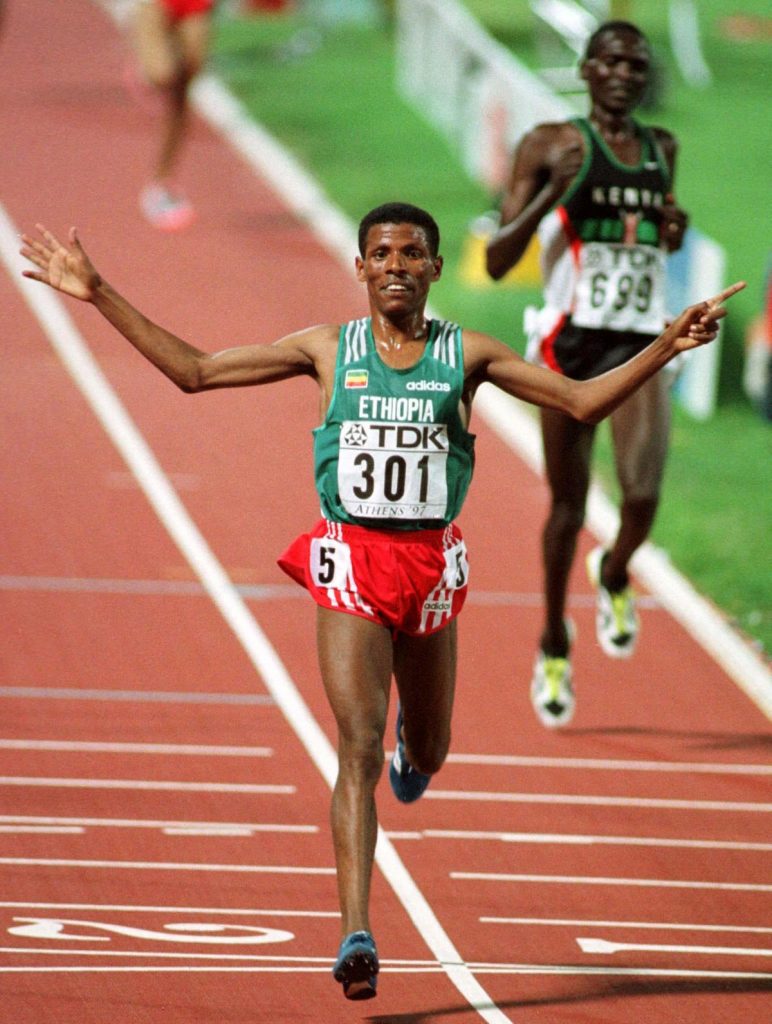
Approaching the 1999 World Indoor Championships
Only weeks away from the World Indoor Championships in Gunma Prefecture, Gebrselassie had to deal with his lower leg ailment.
In the book, Gebrselassie recalled that “the pain in my Achilles tendon was getting worse before I went to Japan.”
Gebrselassie highlighted the challenge he faced in preparing for his two big races in Maebashi in a February 2018 interview with the World Athletics website (the IAAF, or International Association of Athletics Federations, rebranded as World Athletics in 2019).
“The schedule was the problem,” he said before adding, “The event took place over only three days with the 3,000-meter final on Friday, 1,500-meter heats on Saturday and 1,500-meter final on Sunday.”
He then said, “The recovery was very short. Thankfully very few athletes (13) entered the 3,000 meters so it became just a straight final. I was also used to running two rounds of the 10,000 meters at major outdoor championships before 1999 which also helped.”
Continue reading the full column on JAPAN Forward.
 Ed Odeven Reporting